

Investor lending specialists · DSCR, bridge, fix & flip & multi-family
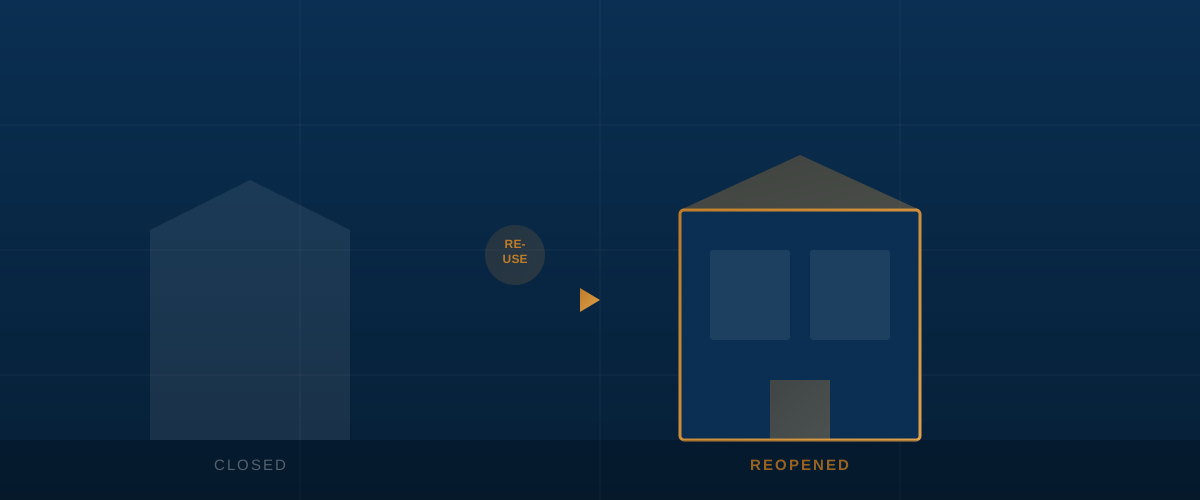
When a Dairy Queen in Great Falls, Montana, closed its doors in June 2026 after 39 years in business, it could have become just another dark storefront on the list of 2026 restaurant closures. Instead, the owner announced he was reopening the building as a Mediterranean restaurant — gyros, hummus, and baklava where the soft serve used to be. In a single decision, a closed icon became a new beginning. That move has a name in real estate: adaptive reuse. And it is one of the most powerful, and most underappreciated, strategies available to investors in 2026.
Adaptive reuse is the art of taking a building designed for one purpose and giving it a second life as something else. It is a former bank branch becoming a restaurant, a shuttered big-box store becoming a medical center, or — as in Great Falls — a closed ice cream shop becoming a completely different kind of eatery. The buildings are already there, already located well, already connected to utilities. What they need is vision and, almost always, the right financing to bridge the gap between "closed" and "reopened." This guide is about how that financing works.
What Adaptive Reuse Actually Means
At its simplest, adaptive reuse means repurposing an existing structure rather than demolishing it or building new. Instead of starting with a bare lot, you start with a building that already has bones — walls, a roof, parking, utility connections, and a location that someone once judged worth investing in. Your job is to reimagine what happens inside.
The Great Falls Dairy Queen is a textbook example. A building purpose-built for frozen treats and a drive-thru window is being reworked into a sit-down Mediterranean concept. The location that drew families for ice cream for four decades will now draw them for gyros and rice bowls. The physical asset stays; the use transforms. That is adaptive reuse in one sentence.
It is worth being clear about why this matters right now. In 2026, closures are creating a steady supply of these buildings — from the 46 Dairy Queens shuttered since 2025 to dozens of locations from other chains. Each one is a candidate for reinvention. For investors and operators willing to look past the brand that just left, the supply of adaptive-reuse opportunities has rarely been richer.
Why Adaptive Reuse Is So Attractive Right Now
There are practical, dollars-and-cents reasons adaptive reuse has moved from a niche strategy to a mainstream one.
- It is usually cheaper than building new. The foundation, structure, parking, and utility connections already exist. Reusing them can cost dramatically less than ground-up construction, and it sidesteps much of the time and expense of new entitlements.
- It is faster. A building that already stands can often be reopened in months rather than the years a new build can take. In a market where speed is money, that timeline advantage is real.
- The locations are proven. These are not speculative sites. They are corners and corridors that national brands already validated with years of operation. You inherit that location advantage.
- Infrastructure carries over. A former restaurant already has the kitchen systems, grease traps, hood vents, and heavy utility service that a new food concept would otherwise pay a fortune to install.
- It can command strong rents or resale value. A well-repositioned building in a great location, serving a fresh use with real demand, often supports higher income than it did in its previous life.
Put simply, adaptive reuse lets you buy proven location and existing infrastructure at a discount, then unlock new value by changing the use. That is a compelling equation — if you can finance it.
The Financing Gap That Bridge Loans Fill
Here is the challenge at the heart of every adaptive-reuse project. When you acquire a closed building, it produces no income. The previous business is gone. There is no tenant, no rent, no stabilized cash flow — and that is precisely what a conventional lender needs to see before writing a long-term loan. You are caught in a gap: the building has no income yet because you have not repositioned it, but you cannot get permanent financing until it has income.
This is the exact gap a bridge loan is built to fill. A bridge loan is short-term, flexible capital designed for properties in transition — the in-between period after you acquire a building and before it is stabilized and refinanced. It lets you move on the opportunity now, on the strength of the deal and the property's potential, rather than waiting for income that does not yet exist.
The bridge loan's job in an adaptive-reuse deal: give you the capital to acquire the closed building and fund the conversion, so you can reposition it into its new use and get it producing income — at which point you refinance into long-term financing or sell.
Bridge financing is comfortable with exactly the things that scare conventional lenders: a property with no current income, a value-add plan that has not been executed yet, and a timeline measured in months. That is why it is the natural first step for nearly every adaptive-reuse project.
The Adaptive-Reuse Deal, Step by Step
It helps to see how the financing threads through the whole project from start to finish. A typical adaptive-reuse deal moves through four stages.
Stage 1: Acquire
You find a closed building — a former franchise restaurant, a vacant bank, a dark retail box — in a location that fits your plan. Because these deals are time-sensitive and the property has no income, you use a bridge loan to close quickly, often while conventional buyers are still waiting on financing.
Stage 2: Reposition
With the building in hand, you execute the conversion: the build-out, the code upgrades, the new signage, whatever the new use requires. The same bridge financing can fund this work, so you are not scrambling for separate construction capital in the middle of the project.
Stage 3: Stabilize
The new use opens or a tenant moves in, and the building starts producing income. This is the moment the property transforms from a speculative bet into a proven, cash-flowing asset — the thing permanent lenders want to see.
Stage 4: Refinance or sell
Now that the building has income, you have options. You can refinance into long-term financing — often a DSCR loan that qualifies on the property's new rental income — to pay off the bridge and hold the asset for cash flow. Or you can sell the finished, income-producing property to another investor at a value well above what you paid. Either way, the bridge loan did its job: it carried you across the gap.
What Kinds of Buildings Work
Adaptive reuse is remarkably flexible. The Great Falls restaurant-to-restaurant conversion is one flavor, but the strategy spans a wide range of transformations:
- Restaurant to restaurant. The simplest conversion, since the food-service infrastructure carries over. A closed fast-food location becomes a new independent concept, as in Great Falls.
- Restaurant or retail to medical. Urgent-care clinics and dental offices love visible pad sites with parking. Converting a former quick-service building into a clinic is a common, high-value play.
- Bank branch to restaurant or retail. Closed bank branches — with their prominent corners and drive-thru lanes — are prime candidates for coffee shops and restaurants.
- Big-box to multiple uses. Larger vacant retail can be subdivided into medical, fitness, entertainment, or even residential and self-storage uses.
- Retail to residential. In the right markets, obsolete commercial space is being converted into apartments and mixed-use housing to meet housing demand.
The common denominator is a sound building in a good location whose original use no longer fits — and an investor with the vision to see the next use and the financing to make it real.
The Risks Worth Respecting
Adaptive reuse is powerful, but it is not effortless. A few risks deserve real attention before you commit.
- Zoning and entitlements. Your new use has to be legally permitted. Confirm zoning early, and if you need a variance or a change of use, build the time and cost into your plan.
- Hidden conversion costs. Older buildings can surprise you — outdated electrical, plumbing, accessibility requirements, or code upgrades triggered by the change of use. Budget a realistic contingency.
- Execution and timeline. Because a bridge loan is short-term, your plan has to actually get done within the window. Repositioning that drags on can pressure your exit. Choose projects and timelines you can deliver.
- Market demand for the new use. A brilliant conversion in a weak trade area still struggles. Validate that real demand exists for what you plan to create before you buy.
- Your exit. Know from day one whether you intend to refinance and hold or sell, because that decision shapes how you structure the deal and the bridge loan from the start.
The investors who do adaptive reuse well are not the ones who avoid these risks — they are the ones who price them in honestly and plan around them. A clear-eyed plan, a realistic budget, and financing that matches the timeline are what separate a profitable conversion from a stalled one.
Bridge Financing vs. Conventional Loans for These Projects
It is worth spelling out exactly why conventional financing rarely works for adaptive reuse, because understanding the difference helps you structure deals correctly from the start. A conventional commercial loan is designed for a stabilized property — one with a track record of income, a signed tenant, and predictable cash flow. The lender's entire model assumes the building is already doing what it is supposed to do. That is a fine fit for a fully leased strip center. It is a terrible fit for a building you just bought empty and intend to transform.
Consider the timeline mismatch alone. A conventional loan can take months to underwrite and close, with layers of committee approval and documentation. Adaptive-reuse opportunities do not wait that long — a well-located closed building attracts multiple interested buyers, and the deal often goes to whoever can close fastest. By the time a conventional lender finishes its process, the building is frequently gone.
Then there is the income problem. Conventional underwriting is built around existing cash flow, and an empty building has none. The whole point of your project is to create that income through repositioning — but the conventional lender wants to see it before lending, which is the exact opposite of what your deal offers. Bridge financing inverts this: it lends against the property and the strength of your plan, not against income that does not exist yet, and it moves at the speed these deals require. That is why bridge loans, not conventional loans, are the standard tool for the acquisition-and-repositioning phase of adaptive reuse.
A Closer Look: Financing a Restaurant Conversion
Return to the Great Falls scenario and imagine you are the investor behind a similar conversion. You find a closed restaurant building on a solid commercial corridor — good visibility, established parking, existing kitchen infrastructure — available at an attractive price precisely because it sits empty. Your plan is to reopen it as a new independent restaurant concept and either operate it yourself or lease it to an operator.
The conventional route is closed to you here: there is no income, no tenant, and no time. So you structure the deal around a bridge loan. The bridge financing funds the acquisition, letting you close quickly and lock up the property before another buyer does. Because the building already has food-service infrastructure — the hood systems, grease traps, and heavy utility service a restaurant needs — your conversion costs are a fraction of what a ground-up build would run, and the same bridge facility can help fund that build-out.
Over the following months, you execute: the interior build-out, the new signage, the code and accessibility upgrades the change of use requires. Then the doors open, or your tenant moves in, and the building starts generating income for the first time since the previous business closed. At that point the property has crossed the line from speculative to stabilized. You refinance the bridge loan into long-term financing — a DSCR loan that qualifies on the building's new rental income — or you sell the finished, income-producing asset. The bridge loan carried you from a dark, empty building to a living business in a proven location, which is exactly what it is designed to do.
Why 2026 Is the Moment for This Strategy
Strategies like adaptive reuse depend on supply, and right now the supply of candidate buildings is unusually strong. The wave of franchise and chain closures moving through 2026 — from the 46 Dairy Queens shuttered since 2025 to dozens of locations across other brands — is continuously putting well-located buildings back on the market. Many of these are closing not because their locations failed, but because of franchise disputes, remodeling mandates, and franchisee cost pressures. That distinction is what makes them ideal adaptive-reuse targets: good real estate, available at a discount, for reasons that have nothing to do with the quality of the location.
At the same time, demand for the uses these buildings can become — medical and urgent care, coffee and quick-service, specialty retail, and in some markets housing — remains strong. When you have rising supply of convertible buildings on one side and steady demand for new uses on the other, the investors positioned in the middle, with vision and financing ready, are the ones who capture the value. That is the window 2026 is opening.
Turning Closures Into Comebacks
Every closed building on the 2026 list is, from one angle, the end of something — a neighborhood institution, a familiar sign, a place people remember. From another angle, it is raw material for a comeback. The Great Falls owner saw it clearly: the building that served ice cream for 39 years did not have to sit empty. It could serve something new.
That is the mindset behind every successful adaptive-reuse project. The location is proven. The infrastructure is there. The only missing pieces are a vision for the next use and the capital to bridge the distance between closed and open. Bridge financing exists precisely to close that distance — to let you acquire a building with potential, reposition it, and carry it to the point where it produces income and qualifies for permanent financing or a profitable sale.
If you are looking at a closed building and can see what it could become, the financing should be the easy part. Send us the project and we will help you structure the bridge loan to make it happen — usually with a real answer within 24 hours.
How to Find Adaptive-Reuse Opportunities
Vision and financing only matter if you can find the right buildings, so it is worth knowing where these opportunities actually surface. The good news is that in 2026, they are not hard to find if you know where to look.
Start with the news itself. The closure stories that fill business headlines — a franchise pulling out of a market, a chain trimming underperforming stores — are, read correctly, a pipeline of soon-to-be-available buildings. When you see that a franchisee has closed locations in your area, those buildings are about to need new owners. Being early to that information is an edge.
Build relationships with commercial real estate brokers who work your target markets. Brokers often know about closures before they hit the listing platforms, and a broker who understands that you are a serious, financing-ready buyer for vacant pad sites will bring you deals first. That relationship is one of the most valuable assets an adaptive-reuse investor can cultivate.
Watch the commercial listing platforms and auction sites, where closed and distressed properties frequently appear. And drive your markets — literally. A closed building with papered windows on a corner you pass every day is a lead that has not yet become a listing. Some of the best deals are found before they are ever formally marketed, by investors paying attention to the physical world around them.
Whatever the channel, the discipline is the same: evaluate the location honestly, confirm the new use is viable and permitted, budget the conversion realistically, and have your financing ready so you can move when the right building appears. Do that consistently and the wave of 2026 closures becomes a steady source of opportunity rather than a stream of sad headlines.