

Investor lending specialists · DSCR, bridge, fix & flip & multi-family
For decades, the initial public offering was treated as the summit of business success — the moment a company "made it" by ringing the bell on Wall Street. So it was striking that when Elon Musk's wealth surged past a trillion dollars in June 2026, the driver was not a public company at all. It was SpaceX, which had spent years as a private company building enormous value entirely outside the public markets before it ever listed. Analysts covering the moment kept making the same point: the old idea that an IPO is the finish line now looks dated. What actually created the wealth was the company's strategic position and scarcity long before Wall Street was involved.
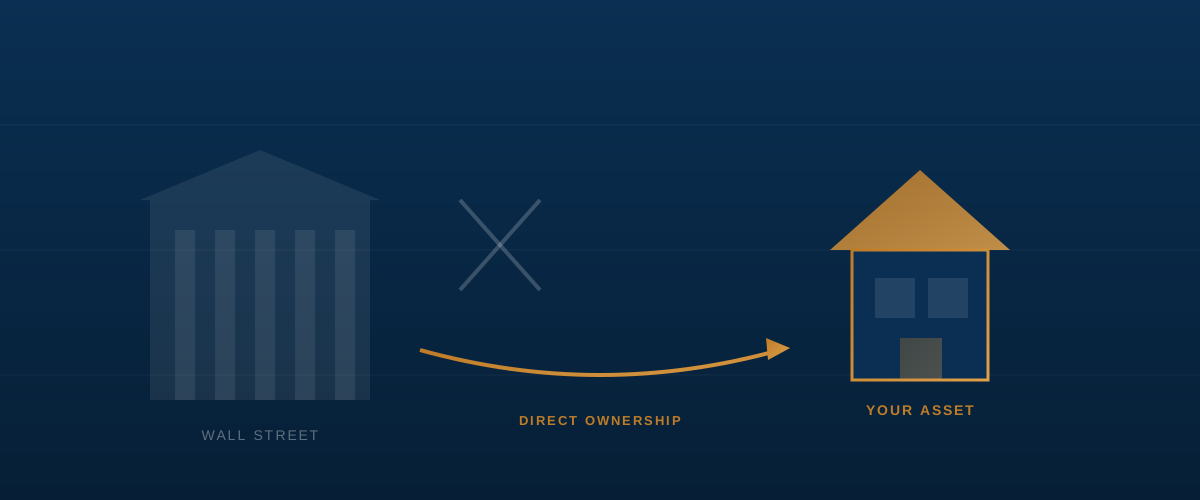
There is a lesson buried in that observation, and it is one real estate investors have quietly lived by for generations: you do not need Wall Street's permission, its machinery, or its validation to build serious wealth. You can own real, valuable, income-producing assets directly — without a ticker symbol, without a brokerage, and without your net worth being subject to the daily whims of public market sentiment. This is about the power of building wealth outside the stock market.
The Wall Street Myth
Most people are taught that investing means one thing: buying stocks. You open a brokerage account, you buy shares of public companies, and you hope they go up. In this framing, Wall Street is the only game in town, and your role is to be a passive passenger hoping the market treats you well.
But this is a remarkably narrow view of what building wealth actually means. The stock market is one avenue — a useful one, but far from the only one, and in many ways not even the one that built the largest fortunes. A great deal of durable wealth in this country has always been built in things you can own directly and control completely: businesses and real estate. These are not paper claims on someone else's enterprise. They are the enterprise itself, owned outright.
Musk's SpaceX wealth is a high-profile reminder of this. The value was created privately, through building something scarce and strategically positioned, long before any public listing. Most of us cannot build a rocket company — but the principle that immense value can be created and held outside the public markets is exactly the principle behind direct real estate ownership.
The Power of Direct Ownership
When you buy a share of stock, you own a tiny, fractional, passive claim on a company you do not control, priced every second by a market you cannot influence. When you buy a rental property, you own the entire asset, outright, and you control every meaningful decision about it. That difference is not small — it changes everything about your relationship to your own wealth.
Consider what direct ownership actually gives you:
- Total control. You choose the asset, set the rent, decide on improvements, and determine when to refinance or sell. You are the decision-maker, not a passenger.
- Direct income. The rent flows to you every month, not a distribution you hope a board declares. You do not need to sell the asset to realize a return.
- Tangible value. The asset is a physical building on real land, anchored to fundamentals you can see and understand, not a valuation set by a distant crowd.
- Privacy and independence. Your wealth is not a public number that fluctuates on a screen for the world to see and react to. It sits quietly in an asset you own.
This is wealth on your own terms. It does not require Wall Street's approval, and it is not subject to Wall Street's mood. In a summer when the richest man's public-facing wealth swung by a trillion dollars on sentiment, the appeal of quiet, directly-owned, income-producing assets is easy to understand.
No Gatekeepers, No Permission
One of the most limiting beliefs in personal finance is that serious investing requires access — the right connections, the right minimum balances, the right approval from institutions. For many exclusive investments, that is true. But real estate is remarkably democratic. You do not need to be an accredited investor, a hedge fund, or a Wall Street insider to buy a rental property. You need a sound property, a sensible plan, and financing that fits.
And crucially, the financing itself does not depend on Wall Street's gatekeeping. A DSCR loan qualifies you based on the property's rental income, not on your position in the financial establishment. The property's ability to pay for itself is what matters. This is financing built for the individual investor building wealth directly, on their own initiative — no institutional permission required.
Income You Don't Have to Sell For
Here is a distinction that sits at the very heart of why direct ownership beats passive stock holding for so many investors. To get money out of a stock, you have to sell it. Your wealth is locked inside the share price, and the only way to access it is to give up the asset — ideally at the right moment, which no one can reliably time, and usually triggering taxes.
A rental property works the opposite way. It pays you while you keep it. Every month, the rent arrives, and if the property is financed sensibly, that income covers the debt and expenses and still leaves cash flow. You are not waiting for a distant liquidity event or trying to guess the top of a market. You are getting paid to own the asset, continuously, and you still own the asset at the end of it. When you do want to access built-up equity, you can refinance and pull cash out without selling — keeping the income stream intact while freeing up capital.
The core advantage: A stock only pays you when you sell it. A rental property pays you to hold it — monthly income now, and access to equity later through a refinance, all without giving up the asset.
Scarcity: The Thing Real Estate Shares With SpaceX
The analysts explaining SpaceX's value kept coming back to scarcity — the company occupies a strategic, hard-to-replicate position, and scarcity commands a premium. Real estate shares this quality in the most fundamental way possible: they are not making more land. A well-located property sits on a finite, irreplaceable resource, and that scarcity is a permanent tailwind for its value.
You cannot manufacture more waterfront, more downtown corners, or more lots in a growing, supply-constrained city. As population grows and demand for housing increases, the fixed supply of good locations becomes more valuable over time. This is scarcity you can actually buy and own — not the speculative scarcity of a hot stock, but the physical, permanent scarcity of land itself. It is one of the deepest reasons real estate has built durable wealth across every generation, entirely independent of what Wall Street is doing.
How to Build Wealth Outside the Market
If the idea of building wealth you own and control directly appeals to you, the path is well-worn and accessible. It does not require a fortune or an insider's access — it requires understanding a few fundamentals and starting.
Begin with cash flow, because directly-owned real estate is powerful precisely because it produces income. Before buying, make sure the rent will comfortably cover the property's full monthly cost — principal, interest, taxes, insurance, and any HOA. That relationship is measured by the debt service coverage ratio, and you can check any property's ratio in seconds with a DSCR calculator. A ratio above 1.0 means the property pays for itself, which is the foundation of the whole approach.
Then align your financing with the direct-ownership mindset. A DSCR loan is purpose-built for this — it lets you finance investment property based on the property's income rather than your personal tax returns, so you can build a portfolio on your own initiative without your W-2 becoming the limiting factor. As you grow, tools like bridge loans and cash-out refinances let you manage and expand your holdings efficiently, all outside the public markets.
Finally, adopt a long-term, ownership mindset. The magic of directly-owned real estate compounds over years — rents rise, loans shrink, equity grows, and scarcity works in your favor, all while the asset pays you to hold it. This is not a get-rich-quick play; it is a build-wealth-steadily play, and it belongs entirely to you.
This Isn't Anti-Stock
To be clear, none of this is an argument that the stock market is bad or that you should never own equities. Public markets have real advantages — liquidity, simplicity, and easy diversification among them — and they deserve a place in most portfolios. The point is not to abandon Wall Street; it is to recognize that it is not the only path, and for many investors, not even the best one for the wealth they most want: tangible, controllable, income-producing assets.
The Musk story simply makes the alternative vivid. The single largest wealth event of his year came from value built privately, outside the public markets, before any listing. For an ordinary investor, the accessible version of "building value outside Wall Street" is direct real estate ownership — and unlike a rocket company, it is genuinely within reach.
Why the Financing Makes This Possible
The single biggest reason ordinary people assume real estate is out of reach is the belief that you need a conventional mortgage — and all the personal-income scrutiny that comes with it — to buy property. For investors, that assumption is outdated. The financing built for this world works differently, and understanding it is what turns "someday" into "now."
A conventional mortgage judges you: your W-2, your tax returns, your personal debt-to-income ratio. That model punishes exactly the people who invest smartly, since serious investors write off income and hold properties in ways that make their personal returns look modest on paper. Investor financing flips the question. Instead of asking what you personally earn, a DSCR loan asks what the property earns. If the rent covers the debt, the deal works — regardless of what your tax return says.
This is why building wealth outside Wall Street is genuinely accessible rather than theoretical. You are not waiting to earn a high enough salary to satisfy a bank. You are finding assets that pay for themselves and financing them on that basis. The property qualifies itself, and you build a portfolio on the strength of the assets rather than the strength of your paycheck. That is the mechanism that makes direct ownership a real path and not just an inspiring idea.
A Realistic Look at the Trade-Offs
Owning assets directly is powerful, but honesty requires acknowledging what you give up compared to buying a stock. Direct real estate is not liquid the way shares are — you cannot sell a rental property with a single click, and turning it back into cash takes time. It also involves responsibility: tenants, maintenance, and management are real work, whether you do it yourself or pay someone to. And it is concentrated; a single property is not diversified the way an index fund is.
None of these are reasons to avoid direct ownership — they are simply the trade-offs that come with control. The investor who wants zero involvement and instant liquidity may prefer paper assets, and that is a legitimate choice. But the investor who wants tangible assets that produce income and respond to their own effort accepts a little illiquidity and responsibility in exchange for control and cash flow. Understanding that trade honestly is what separates a sound long-term strategy from a naive one. The goal is not to pretend real estate has no downsides, but to decide clearly which set of trade-offs fits the wealth you are trying to build.
Two Investors, Two Paths
To make the difference concrete, picture two investors who each set aside the same amount of capital to build wealth over a decade.
The first puts everything into a portfolio of public stocks. Her money is liquid and diversified, and in good years the account balance climbs impressively. But she is a passenger. She cannot influence how any of those companies are run, she cannot force a single one to pay her income, and her net worth lurches with every market cycle — soaring in the booms and sinking in the busts, entirely outside her control. When she needs cash, her only option is to sell shares, sometimes at exactly the wrong moment.
The second investor uses her capital as down payments to acquire rental properties, financing each one with a DSCR loan that qualifies on the property's rent rather than her personal income. Her wealth grows more quietly, but it grows on her terms. Each property pays her rent every month whether the market is up or down. She can raise rents, improve the buildings, refinance to pull out equity, or sell on her own timeline. Her net worth is not a number a stranger reprices each morning — it is a set of real, controllable assets she can point to. Neither path is objectively "right," but they produce very different experiences of wealth: one dependent on the market's mood, the other grounded in assets the investor actually controls.
Getting Started Outside the Market
If the idea of building wealth you can see and control appeals to you, the path in is more accessible than the stock-market-only narrative suggests. You do not need to be wealthy already, and you do not need Wall Street's machinery.
The starting point is a single income-producing property. Because investor financing qualifies on the property's cash flow rather than your personal tax returns, the barrier to entry is lower than many people assume — you are not being judged on your W-2, you are being judged on whether the deal makes sense. From that first property, the same principles compound: as each one builds equity and income, you can refinance or leverage it to acquire the next, gradually assembling a portfolio of tangible, cash-flowing assets entirely outside the public markets.
The tools are straightforward. A DSCR calculator tells you whether a property covers its own debt before you buy. A DSCR loan finances it on that cash flow. And as you scale, options like bridge loans let you hold multiple properties efficiently. None of it requires a brokerage account, a ticker symbol, or anyone's permission — just a good asset and financing built around it.
Your Wealth, On Your Terms
The old story said the stock market was the only real way to invest, and the IPO was the ultimate goal. The Musk headlines quietly punctured that story: the biggest fortune of the moment was built privately, and even at a trillion dollars, that public-facing wealth swung wildly on sentiment. The deeper lesson is that the most durable wealth is often the kind you own and control directly.
Real estate investors have always understood this. They do not need Wall Street's permission or its validation. They buy tangible, scarce, income-producing assets, finance them on the strength of the property itself, and build wealth quietly on their own terms — wealth that pays them to hold it and does not evaporate when the market has a bad week. If you are ready to build that kind of wealth, that is exactly what we help investors finance. Send us your scenario and we will show you how to structure it — usually with a real answer within 24 hours.