

Investor lending specialists · DSCR, bridge, fix & flip & multi-family
In June 2026, Elon Musk did something almost no one in history has done: he became a trillionaire. When SpaceX went public, the surge in his private holdings briefly pushed his net worth past the $1 trillion mark. And then, within a week, it was gone. As SpaceX's stock wobbled and investors struggled to figure out how to value the company, Musk slipped back below that line. By early July, Forbes placed his fortune at roughly $997 billion — still staggering, but a vivid reminder that even the richest man on Earth watches his wealth swing by tens of billions of dollars in the space of days.
For most of us, a trillion-dollar swing is an abstraction. But underneath the headline sits a lesson that applies directly to how ordinary investors build and protect wealth — a lesson that has nothing to do with rockets and everything to do with the difference between wealth you can see on a screen and wealth you can actually hold. This is a story about hard assets, and why real estate investors have quietly understood something that the Musk headlines make impossible to ignore.
The Problem With Paper Wealth
Musk's fortune is almost entirely "paper wealth" — the value of shares in companies like SpaceX, Tesla, and xAI. On paper, that wealth is enormous. But it has two properties that make it fragile. First, it is only worth what the market says it is worth at any given moment, and markets change their mind constantly. Second, it is not liquid in the way cash is; you cannot spend a share of an unlisted rocket company at the grocery store.
That is why Musk's net worth can rise above a trillion dollars and fall back below it in a single week without him buying or selling anything at all. The underlying companies did not change overnight. What changed was sentiment — investors' collective guess about what those companies are worth. As one commentator put it during the failed CNBC interview, investors were simply having a hard time figuring out how to value SpaceX, and that uncertainty alone knocked billions off Musk's number.
Here is the uncomfortable truth this reveals: paper wealth is a story the market tells about you, and the market can change the story at any time. If the world's richest person is subject to that volatility, so is every investor whose net worth lives primarily in stocks. That is not an argument against owning equities — it is an argument for understanding what you actually own, and for balancing it with something more grounded.
What Makes an Asset "Hard"
A hard asset is something tangible with intrinsic value — something you can touch, use, and that does something useful in the real world regardless of what a ticker says. Real estate is the classic hard asset. A rental property is not an abstraction. It is a physical building that houses people, sits on land that cannot be manufactured more of, and produces rent every single month whether or not anyone is watching a stock chart.
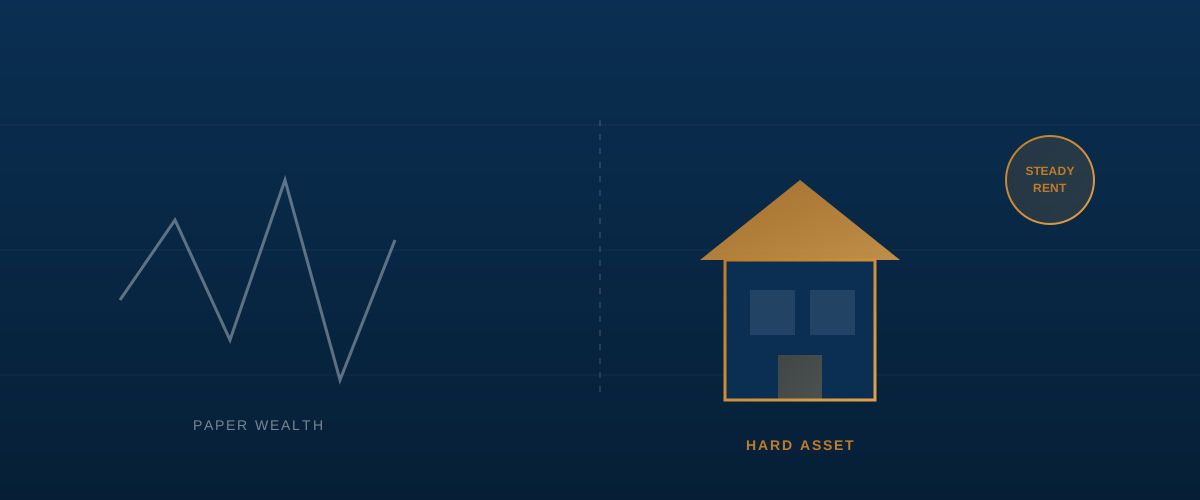
The contrast with paper wealth is stark. Consider what happens to each on a random Tuesday when the market has a bad day:
- Paper wealth can drop 3, 5, or 10 percent in hours based on sentiment, a disappointing interview, or a rumor — exactly the kind of swing that cost Musk his trillionaire status.
- A rental property does not care about the market's mood. The tenant still pays rent on the first of the month. The building still stands. The land is still there. Its value is anchored to something real: shelter, location, and cash flow.
This is the quiet power that real estate investors have understood for generations. They are not chasing the explosive, headline-grabbing gains of a tech IPO. They are building wealth on a foundation that does not evaporate when sentiment shifts. It is less exciting and far more durable.
Cash Flow: The Thing Paper Wealth Can't Give You
There is a second, even more important difference. Musk's trillion dollars, for all its size, does not pay him anything. Shares in a growth company do not send you a check every month. To turn that paper wealth into spendable money, you have to sell — and selling means timing the market, triggering taxes, and giving up the asset.
A rental property does the opposite. It pays you to hold it. Every month, the rent arrives, and if the property is financed sensibly, that rent covers the mortgage, the taxes, the insurance, and still leaves cash in your pocket. You are not waiting for a distant payday when you finally sell. You are getting paid to own the asset, month after month, while it also appreciates over time.
The core distinction: Paper wealth is a number that goes up and down and only becomes real when you sell. A cash-flowing property is an asset that pays you to hold it — income now, appreciation later, and a tangible thing you control the entire time.
This is precisely why the debt service coverage ratio — the metric at the heart of investor lending — matters so much. A DSCR loan qualifies you based on whether the property's rent covers its own debt. It is a financing model built entirely around cash flow, around the property paying for itself, which is the opposite philosophy of speculative paper wealth. You can check any property's ratio in seconds with our DSCR calculator.
Control: You Can't Steer a Stock, But You Can Steer a Building
When you own shares in a company, you are a passenger. You have no say in how it is run, when it goes public, or what its founder does on any given day. If Musk decides to skip an interview and the stock dips, your wealth dips with it, and there is nothing you can do about it. Your outcome is entirely in someone else's hands.
Real estate flips that dynamic. When you own a rental property, you are the one making the decisions. You choose the property, the market, and the tenant. You decide when to raise the rent, when to renovate to increase value, when to refinance to pull out equity, and when to sell. You can improve the asset directly with your own effort and capital in a way that is simply impossible with a share of stock. That control is a form of risk management that paper wealth can never offer.
The Leverage Difference
There is one more contrast worth drawing, because it is where real estate quietly outperforms even the flashiest paper wealth. To buy $500,000 of stock, you generally need $500,000. But to control a $500,000 property, you might put down a fraction of that and finance the rest. Your money controls a much larger asset, and the tenant's rent pays down the loan over time.
This is responsible leverage — using financing to control a productive, cash-flowing asset, with the income from that asset covering the debt. It is a fundamentally different thing from borrowing to gamble on a stock price. The property produces the money that services its own loan. Over years, that combination of leverage, cash flow, and appreciation is how ordinary investors build extraordinary wealth without ever needing a trillion-dollar headline. A DSCR loan is one of the most common tools for exactly this, because it lets you finance investment property based on the property's income rather than your personal tax returns.
This Isn't Either-Or
None of this is an argument that you should sell all your stocks and put everything into real estate. Diversification is wise, and equities have a real place in a balanced portfolio. Musk himself did not get rich by avoiding risk — he got rich by taking enormous, concentrated bets.
The point is more subtle. The Musk headlines are a reminder that wealth concentrated in volatile paper assets is wealth that can swing wildly and that you do not fully control. For most investors — who are not building rocket companies — balancing that volatility with tangible, cash-flowing hard assets is not a step backward. It is how you build a foundation that stays standing when the market has a bad week. Real estate is the ballast that steadies the ship.
A Pattern as Old as Markets Themselves
What happened to Musk in the summer of 2026 is not new. It is the latest chapter in a story markets have told over and over. In the dot-com boom, fortunes were made and vaporized on paper in months. In 2008, portfolios that looked bulletproof lost half their value while the houses people actually lived in kept sheltering them. Time and again, the wealth that proved most durable through turmoil was not the cleverest paper position — it was the tangible, income-producing asset that kept doing its job.
The reason is structural, not emotional. Paper assets are priced by markets in real time, and markets are driven by crowds, and crowds swing between greed and fear. A hard asset like a rental property is priced far more slowly, anchored to fundamentals like local rents, replacement cost, and the simple, permanent human need for shelter. Those fundamentals do not panic. They do not check the news at noon and decide to sell. That is why, across every boom and bust, real estate has remained a cornerstone of how durable wealth is built — not because it is glamorous, but because it is grounded.
Musk's story simply makes the pattern impossible to ignore because of its scale. When the richest person alive can lose a trillion dollars of paper value in a week, it forces a question every investor should ask: how much of my own wealth is a number that could move like that, and how much is anchored to something real?
A Simple Comparison
To make the contrast concrete, imagine two investors who each set aside $100,000 in early 2026. The first puts it entirely into a high-flying growth stock. The second uses it as the down payment on a rental property worth several times that amount, financing the rest with a DSCR loan and renting it out.
Over the following year, the stock investor watches their $100,000 swing dramatically — up 20 percent one month on optimism, down 15 percent the next on a bad earnings call or a founder's misstep. Their wealth is real only on the day they sell, and selling means guessing the right moment and paying capital gains. Along the way, the position pays them nothing; it simply fluctuates.
The real estate investor's experience is entirely different. Their property's value moves slowly and modestly, but every single month the tenant pays rent. That rent covers the mortgage, taxes, and insurance, and leaves cash flow on top. The loan balance shrinks a little each month as the tenant effectively pays it down. And because the investor used leverage, they control an asset far larger than their $100,000, so even modest appreciation on the full property value translates into a strong return on their actual cash invested. One investor spent the year watching a number bounce; the other spent it collecting rent and building equity. (These figures are illustrative; real outcomes depend on the market, the property, and the financing.)
How to Start Building Hard-Asset Wealth
The good news is that building wealth in tangible, cash-flowing real estate does not require a rocket company or a trillion-dollar valuation. It requires a sound property, sensible financing, and a long-term mindset. Here is the basic path most investors follow.
Start by understanding cash flow, because it is the whole game. Before buying anything, you want to know that the property's rent will comfortably cover its full monthly cost — the principal, interest, taxes, insurance, and any HOA. That relationship is captured in the debt service coverage ratio, and a ratio above 1.0 means the property pays for itself. Running the numbers with a DSCR calculator before you make an offer is the single most important habit a new investor can build.
Next, get your financing right. Conventional mortgages judge you on your personal tax returns, which is a poor fit for investors who write off income or hold properties in an LLC. A DSCR loan instead qualifies the loan on the property's rental income, which is exactly aligned with the hard-asset, cash-flow philosophy. It lets you scale a portfolio without your personal income becoming the bottleneck.
Finally, think in decades, not days. The power of hard assets compounds over time — rents rise, loans get paid down, and properties appreciate, all while the asset pays you to hold it. The investor who buys one sound property and holds it patiently, then uses its growing equity to buy the next, is running exactly the opposite strategy from someone watching a stock ticker swing at noon. It is slower. It is also far more durable.
Three Myths That Keep People in Paper
If hard assets are so durable, why do so many people keep the bulk of their wealth in volatile paper positions? Usually it comes down to a few persistent myths worth clearing up.
Myth one: real estate is only for the wealthy. This is the opposite of the truth. Because real estate uses leverage, it is one of the few asset classes where an ordinary investor can control a substantial, income-producing asset with a modest amount of their own cash. You do not need to be a billionaire; you need a sound property and financing that fits. The DSCR model exists precisely so that everyday investors can qualify on the property's income rather than needing an enormous personal balance sheet.
Myth two: real estate is too much work. People imagine midnight calls about broken toilets. In reality, the level of involvement is a choice. Investors who want to be hands-off use property managers, and the cost of management is simply built into the cash-flow math. Compared with the constant anxiety of watching a volatile portfolio, many investors find a well-managed rental far less stressful, not more.
Myth three: you'll miss the big gains. The fear of missing a rocketing stock is real, but it cuts both ways — for every stock that soars, others crater, and timing them is notoriously hard even for professionals. Hard-asset investing trades the lottery-ticket upside for something most people actually want more: steady, compounding, controllable wealth that pays them along the way. Musk's week is the perfect illustration — the same volatility that can add a trillion dollars can take it right back.
None of this means paper assets are bad or that real estate is risk-free. Every investment carries risk, and real estate has its own — vacancies, maintenance, and market cycles among them. The point is simply that a portfolio anchored partly in tangible, cash-flowing assets is a portfolio with a foundation, and foundations matter most exactly when the market is having its worst week.
The Real Lesson Behind the Headline
Musk's trillion-dollar week, and the way it vanished, is genuinely fascinating. But strip away the celebrity and the sheer scale, and what remains is a lesson as old as investing itself: there is a difference between wealth that exists as a number and wealth that exists as a thing. One can disappear with a change in mood. The other pays you rent, shelters a family, and sits on land that no one can print more of.
Real estate investors have always known this. They are not trying to become trillionaires overnight. They are building durable, cash-flowing wealth one property at a time — the kind that does not care what the market thinks on any given Tuesday. In a week where the richest man alive lost and regained a fortune the size of a small nation's economy, that quiet, grounded approach looks wiser than ever.
If you are ready to build wealth on hard assets that pay you to own them, that is exactly what we help investors finance. Send us your scenario and we will show you how to structure it — usually with a real answer within 24 hours.