


Investor lending specialists · DSCR, bridge, fix & flip & multi-family
When Elon Musk's net worth rocketed past a trillion dollars in June 2026 on the strength of the SpaceX IPO, most coverage focused on the eye-popping number. But the more instructive story for everyday investors is not how much Musk is worth — it is how he got there. Musk did not build SpaceX, Tesla, and his other ventures by writing personal checks for everything. He built them by mastering the art of deploying capital that was not his own: investor money, debt, partnerships, and reinvested earnings, all directed toward assets that could grow far beyond what his own cash alone could ever fund.
That principle — using other people's money to control assets larger than you could buy outright — is not exclusive to billionaires and rocket companies. It is, in fact, the single most powerful and accessible wealth-building tool available to ordinary real estate investors. It even has a name: leverage. This is a look at what Musk's empire reveals about leverage, and how real estate investors use the same principle to build serious wealth.
What Leverage Really Means
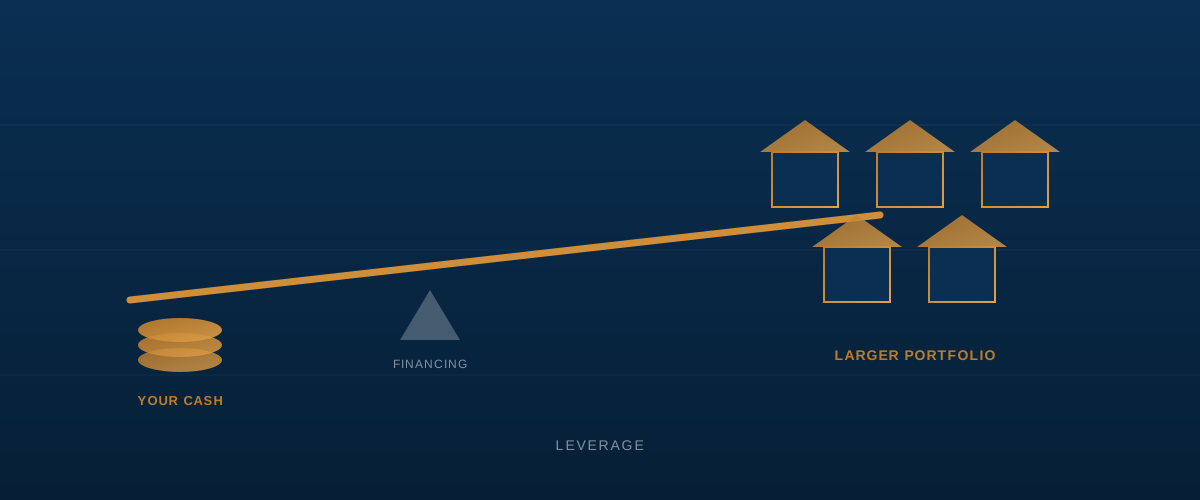
Leverage, at its core, is using borrowed capital to control an asset worth more than the cash you put in. Instead of paying the full price of something yourself, you contribute a portion and finance the rest, which lets you command a much larger asset — and capture the returns on that larger asset — with a limited amount of your own money.
Billionaires understand this instinctively. Almost no large fortune is built on cash alone; it is built on the intelligent use of debt, investor capital, and partnerships to control and grow assets. Musk's companies raised billions from outside investors and used it to build things his personal wealth never could have funded directly. The value those assets created then flowed back to him as the owner. That is leverage operating at an enormous scale — but the underlying mechanic is identical to what a first-time investor does when they buy a rental property with a down payment and a loan.
The Power of Other People's Money
Real estate is arguably the most accessible leveraged investment available to ordinary people, precisely because lenders are so willing to finance it. Consider the fundamental math: if you buy a $400,000 property with a 25 percent down payment, you are controlling a $400,000 asset with just $100,000 of your own money. Every dollar of appreciation, every dollar of rent, and every dollar of loan paydown accrues to you — the owner — even though three-quarters of the purchase was financed with someone else's capital.
This is the quiet engine behind most real estate fortunes. It is why an investor with, say, $200,000 in capital does not simply buy one $200,000 property in cash. Deployed as down payments, that same $200,000 can control a million dollars or more of real estate — multiple properties, each producing rent, each building equity, each appreciating on the full property value rather than just the slice the investor paid for.
The leverage principle: With $100,000 you can buy one $100,000 property in cash, or use it as down payments to control $400,000–$500,000 of real estate. The leveraged investor earns returns on the larger amount — that is how the same capital builds far more wealth.
Why Real Estate Is Built for Leverage
Not all assets lend themselves to leverage equally. You cannot easily borrow 75 percent of the cost of a stock portfolio at attractive terms — and if you try, a market dip can trigger a margin call that forces you to sell at the worst possible moment. Real estate is different, and better suited to leverage, for several reasons:
- Lenders trust it as collateral. Property is tangible, durable, and holds value, so lenders will finance a large share of its cost at reasonable rates — something they will not do for most other assets.
- The asset itself pays the debt. A rental property produces income that services its own loan. The tenant, in effect, pays down your mortgage while you hold the asset. No stock does that.
- No margin calls. As long as you make your payments, a dip in your property's paper value does not force a sale the way a margin call on a stock portfolio can. That stability makes real estate leverage far safer to hold.
- Long, fixed terms. Real estate debt can be locked in for years or decades, giving you predictable costs while rents and values tend to rise over time.
This combination — generous financing, self-servicing debt, and stability — is what makes real estate the leveraged asset of choice for wealth-builders at every level, from the first-time investor to the institutional fund.
How Investors Access This Leverage
The practical question is how an investor actually taps this leverage, especially if their personal income does not fit a conventional bank's narrow box. This is where investor-focused financing comes in, and where the parallel to Musk's approach becomes concrete: just as his ventures were financed on the strength of the assets and their potential rather than his personal paycheck, investor loans are underwritten on the strength of the property.
A DSCR loan is the clearest example. It qualifies based on the property's cash flow — its debt service coverage ratio — rather than your personal tax returns. That means you can leverage into income-producing property based on whether the deal works, not on whether your W-2 satisfies a bank. For investors who write off income or hold properties in entities, this is often the difference between being stuck and being able to scale.
Other tools extend the same principle across the investing lifecycle. A bridge loan provides short-term leverage to acquire or reposition a property quickly. A cash-out refinance lets you pull leverage back out of a property you already own — freeing up capital to redeploy into the next deal without selling the first. And as your holdings grow, a bridge loans lets you leverage multiple properties efficiently under one facility.
Recycling Capital: How the Wealthy Compound
Here is where leverage becomes genuinely powerful, and where it most resembles how large fortunes actually compound. The sophisticated investor does not just leverage once. They recycle the same capital again and again.
The cycle works like this: you buy a property with a down payment and a loan. You improve it and let it appreciate and build equity as the rent pays down the debt. Then you refinance — pulling your original capital back out through a cash-out refinance — and you redeploy that same capital as the down payment on the next property. Your original money is now working in two properties at once. Repeat this, and a modest starting sum can control an ever-growing portfolio, each property leveraged, each producing income, each building equity simultaneously.
This is the real-estate version of what Musk does at scale when value created in one venture supports and funds the next. The investor recycling capital across a growing portfolio is running the same playbook: using leverage not as a one-time trick but as a repeatable engine that compounds control and cash flow over time. It is precisely how so many people have built substantial wealth from ordinary beginnings.
A Worked Example: Leverage in Action
Numbers make the power of leverage concrete. Imagine two investors, each starting with $150,000 in capital, taking two different approaches over several years.
The first buys a single $150,000 rental property in cash. It is a fine investment — it produces rent, it appreciates, and there is no debt to service. If the property appreciates 4 percent in a year, the investor gains $6,000 on their $150,000, and they collect the rent free and clear. Solid, but limited.
The second investor uses the same $150,000 as three $50,000 down payments, controlling three $200,000 properties — $600,000 of real estate in total — each financed with a DSCR loan that qualifies on the properties' rents. Now if real estate appreciates that same 4 percent, the gain is calculated on $600,000, not $150,000: roughly $24,000 in a year, four times the unleveraged investor's gain. Meanwhile, three tenants are paying down three loans, building equity in all three properties at once. The leveraged investor took on responsibility and debt — but their capital is working four times as hard. (Figures are illustrative; real returns depend on the market, the properties, and the terms.)
That multiplier is the entire point of leverage. The same starting capital, deployed with financing instead of paid all-in, controls far more asset and captures returns on the larger amount — which, compounded over years, is the difference between a modest portfolio and a substantial one.
The Different Tools of Leverage
Leverage is not a single product; it is a set of tools you deploy at different moments in an investment's life. Understanding which tool fits which moment is part of using leverage well.
- Acquisition leverage — a standard investor loan or DSCR loan that lets you buy a property with a down payment rather than the full price. This is the foundational form of leverage most investors start with.
- Short-term leverage — a bridge loan that funds a fast acquisition or a repositioning before you move to long-term financing. Useful when speed matters or the property is not yet stabilized.
- Equity-release leverage — a cash-out refinance that pulls capital back out of a property you already own, so you can redeploy it without selling. This is the tool that powers capital recycling.
- Portfolio leverage — a bridge loans that finances multiple properties under one facility, letting you leverage a whole collection of assets efficiently as you scale.
A sophisticated investor moves between these tools fluidly — acquiring with one, repositioning with another, releasing equity with a third, and consolidating with a fourth. Each is a form of leverage suited to a particular stage, and together they form a complete toolkit for building and growing a portfolio with borrowed capital used intelligently.
Respecting the Risks of Leverage
Leverage is a powerful tool, and like any powerful tool it must be respected. The same force that multiplies your gains can multiply your losses if used carelessly, and no honest discussion of leverage is complete without saying so plainly.
- Over-leverage is the classic mistake. Borrowing so much that a property barely covers its debt — or does not — leaves no cushion for vacancies, repairs, or rate changes. Prudent investors keep a margin of safety, targeting cash flow that comfortably exceeds the debt.
- Cash flow is your protection. The reason a DSCR-qualified property is a relatively safe use of leverage is that the asset itself services the debt. Buying properties that genuinely cash-flow — not ones that only work on optimistic assumptions — is the single best defense against the downside of leverage.
- Reserves matter. Leverage without reserves is fragile. Holding cash to cover a few months of payments turns an unexpected vacancy from a crisis into an inconvenience.
- Know your exit. Understand how and when you would refinance or sell before you borrow, so leverage never traps you.
Used with discipline — reasonable loan-to-value, genuine cash flow, and adequate reserves — leverage is not reckless. It is the responsible, time-tested mechanism behind most real estate wealth. Used carelessly, it is dangerous. The difference is entirely in the discipline of the investor. You can check whether a property covers its debt comfortably before you ever borrow by running the numbers through a DSCR calculator.
Common Misconceptions About Leverage
Because leverage involves debt, it attracts a lot of fear and misunderstanding. Clearing up the most common misconceptions helps investors use it wisely rather than avoid it out of misplaced caution.
"All debt is bad." This is perhaps the most costly misconception in personal finance. There is an important difference between consumer debt — borrowing to buy things that lose value — and investment debt used to acquire an income-producing asset that pays down its own loan and appreciates. The first drains you; the second builds wealth. Treating them as the same thing keeps many people from ever building real estate wealth.
"I should pay off my properties as fast as possible." Paying down debt feels safe, and reducing leverage has its place — but rushing to own everything free and clear can dramatically slow your growth. Capital locked into paying off one property is capital that is not acquiring the next. Many successful investors deliberately maintain reasonable leverage precisely so their capital keeps working across a growing portfolio rather than sitting idle in a single paid-off asset.
"Leverage is gambling." Used recklessly, borrowing can be. But disciplined leverage — reasonable loan-to-value, properties with genuine cash flow, adequate reserves — is the opposite of gambling. It is a calculated, time-tested strategy with a clear margin of safety. The gambler over-leverages on optimistic assumptions; the investor leverages conservatively on assets that pay for themselves. Same tool, entirely different discipline.
Leverage the Billionaire Doesn't Have Better Access To
Here is the genuinely encouraging part. When it comes to real estate leverage specifically, the ordinary investor's access is not dramatically worse than the billionaire's. A first-time investor putting 25 percent down on a rental is using the exact same principle — controlling a large asset with a fraction of its cost, letting the asset service its own debt — that drives fortunes many orders of magnitude larger.
The mechanics scale, but the concept is identical. That is what makes real estate such a democratic wealth-building tool: you do not need to be a billionaire to leverage intelligently. You need a good asset, financing built around its cash flow, and the discipline to use debt responsibly. The billionaire's advantage is scale, not access to the fundamental idea.
Putting the Lesson to Work
Elon Musk's trillion-dollar moment was built on a principle available, in its essence, to anyone: deploy capital — including other people's — to control and grow valuable assets. In real estate, that principle is not abstract or out of reach. It is the everyday mechanic of buying property with a down payment and a loan, letting the tenant pay down the debt, recycling equity into the next deal, and compounding control and cash flow over time.
You do not need a rocket company to leverage like this. You need a property that pays for itself and financing designed around that cash flow — which is exactly what investor lending provides. Used with discipline, leverage is how ordinary investors build extraordinary portfolios.
If you are ready to put leverage to work on a real deal, that is precisely what we help investors do. Send us your scenario and we will show you how to structure the financing — usually with a real answer within 24 hours.