


Investor lending specialists · DSCR, bridge, fix & flip & multi-family
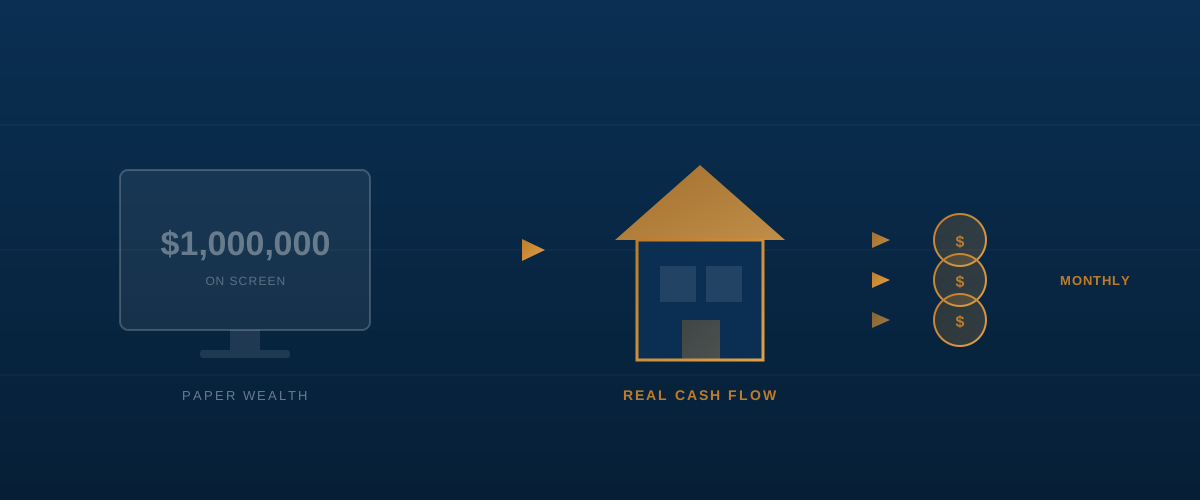
In the summer of 2026, Elon Musk was briefly worth over a trillion dollars. Yet here is a detail that rarely makes the headlines: almost none of that trillion was money he could actually spend. It was the paper value of his ownership stakes — a number on a screen, not cash in an account. To turn even a fraction of it into spendable money, he would have to sell shares, and doing so at scale would move the very market that sets the price. His fortune, in other words, was enormous but largely illiquid, a measure of net worth rather than a stream of income.
This points to a distinction that sits at the very heart of how wealth actually works, and one that too many investors overlook: the difference between net worth and cash flow. A big number on paper is not the same as money arriving in your account every month. And for the investor who wants not just to look wealthy but to live on their wealth, that distinction changes everything. This is the case for owning assets you can touch — assets that pay you real, spendable cash flow rather than just appreciating on a screen.
Net Worth Versus Cash Flow
Most people, when they think about wealth, think about net worth — a single number representing the total value of everything you own. It is how we rank billionaires and how many investors measure their own progress. But net worth is a snapshot, not an income. It tells you what your assets are theoretically worth if you sold them, not what they put in your pocket while you hold them.
Cash flow is different. Cash flow is money that actually arrives — income you can spend, save, or reinvest without selling anything. A person with a modest net worth but strong, reliable cash flow may live far more comfortably and securely than someone with a large net worth locked up in assets that produce no income. The trillionaire whose wealth is entirely in appreciating shares has an enormous net worth and, from those shares, essentially zero cash flow until he sells.
This is not to pity Musk — he has plenty of ways to access liquidity. The point is conceptual and it applies at every level: an asset that only appreciates makes you wealthier on paper, but an asset that produces cash flow pays you while you own it. For most investors, especially those who want their money to support their life rather than just sit on a statement, cash flow is the more useful and more powerful form of wealth.
What Cash-Flowing Real Estate Actually Does
A rental property is, in essence, a cash-flow machine. You own the asset, and every month it produces income in the form of rent. After the expenses and the loan payment, what remains is cash flow — real money that lands in your account without you having to sell anything or wait for a favorable market.
This is a fundamentally different experience of wealth than holding an appreciating stock. Consider what the rental gives you that the paper asset does not:
- Spendable income now. You do not have to sell the property to benefit from it. The rent arrives while you continue to own the asset — and while it potentially appreciates on top of that.
- Income independent of market mood. The rent does not care whether the stock market is up or down that day. A tenant pays their rent in booms and busts alike, which makes real estate cash flow remarkably steady compared to paper gains.
- Cash flow that tends to rise. Rents generally increase over time, which means a rental's income stream tends to grow — often keeping pace with or outrunning inflation — while your fixed-rate loan payment stays the same.
- An asset that appreciates too. Crucially, you do not give up appreciation to get cash flow. A well-chosen rental can appreciate and pay you monthly income — you get both, where a growth stock gives you only the former, and only when you sell.
This combination — spendable monthly income from an asset that can also grow in value — is what makes cash-flowing real estate such a powerful wealth vehicle. It pays you to wait.
Cash Flow Is What Actually Buys Freedom
Ask people what they really want from wealth, and most do not say "a large number on a statement." They say something closer to freedom — the ability to cover their expenses without trading their time for a paycheck, to weather emergencies, to choose how they spend their days. And freedom, in financial terms, is fundamentally a cash-flow phenomenon, not a net-worth one.
Think about it concretely. What lets someone stop depending on a job is not a big net worth they cannot touch — it is enough reliable monthly income to cover their monthly costs. That is precisely what a portfolio of cash-flowing rentals is designed to produce. Each property adds a stream of income, and as those streams grow and stack, they can eventually cover a person's living expenses entirely. The moment your cash flow exceeds your costs, you have bought yourself genuine financial freedom — regardless of whether your net worth is in the millions.
This is why so many investors focused on independence prioritize cash flow over pure appreciation. A million dollars of appreciating stock is wonderful, but you cannot pay your electric bill with it unless you sell. A collection of rentals throwing off steady monthly income pays the bill directly, every month, while the underlying assets keep appreciating in the background. One is a number; the other is a life.
Financing Built Around Cash Flow
If cash flow is the goal, then the ideal financing is the kind built around cash flow itself — and that is exactly what investor lending provides. A DSCR loan qualifies a property based on its debt service coverage ratio, which is simply a measure of how well the rent covers the loan payment. In other words, the financing is underwritten on the property's cash flow, the very thing you are investing for.
This alignment is elegant. You want an asset that produces reliable income; the lender wants to see that the asset produces reliable income; and the loan is structured around exactly that. There is no mismatch between your goal and the financing. You are not qualifying on your personal salary or your tax returns — you are qualifying on the strength of the cash flow the property throws off, which is precisely what you care about as a cash-flow investor.
Check the cash flow first: Before buying, run a property's numbers through a DSCR calculator. A ratio of 1.25 or higher means the rent comfortably covers the debt — a concrete, knowable measure of the cash flow you are buying, before you commit a dollar.
Building a Cash-Flow Portfolio
Turning this idea into reality is a matter of stacking income streams deliberately over time. It starts with a single cash-flowing property — one asset producing more rent than it costs to own. That first property proves the model and begins generating income.
From there, the strategy is repetition. As each property builds equity, you can refinance to pull capital out and acquire the next cash-flowing asset, adding another income stream without necessarily adding new capital from your own pocket. Property by property, the streams stack: two rents, then three, then five, each contributing to a growing river of monthly income. As the portfolio grows, tools like bridge loans let you finance multiple properties efficiently, and a cash-out refinance lets you keep recycling capital into new income streams.
The endpoint of this process is the one most investors are really chasing: a portfolio whose combined cash flow covers, and eventually exceeds, your living expenses. That is not a paper number you hope to sell into someday. It is money arriving every month from assets you own and control — the tangible, spendable version of wealth.
Why Rental Cash Flow Beats Most Other Income
Not all income is created equal, and rental cash flow has qualities that make it especially valuable compared to the alternatives most people rely on.
Compare it first to a salary. A paycheck requires you to show up and trade your time for it — the moment you stop working, it stops. Rental income keeps arriving whether you work that month or not, because it comes from an asset rather than your labor. That independence from your own time is what makes it a foundation for freedom in a way a salary never can be.
Compare it next to stock dividends. Dividends are genuinely passive income, and they have their place — but they are typically a small percentage of the stock's value, and companies can cut them at will. Rental cash flow tends to be a more substantial return relative to your invested capital, especially when amplified by sensible leverage, and it is backed by a tangible asset and a lease rather than a board's quarterly decision.
Finally, compare it to simply drawing down savings. Living off a fixed pot of money means watching it shrink and hoping it lasts. Cash-flowing real estate does the opposite: it produces income without depleting the asset. The property remains, keeps appreciating, and keeps paying. That combination — income that does not require your time, is substantial relative to capital, and does not consume the underlying asset — is what places well-run rental cash flow among the most powerful forms of income an ordinary investor can build.
The Cash-Flow Math in Practice
To ground this in numbers, consider a straightforward rental scenario. An investor buys a property that rents for $2,400 a month. After the mortgage payment, taxes, insurance, and a realistic allowance for maintenance and vacancy, suppose $500 a month remains. That $500 is cash flow — real, spendable income arriving every month from a single property, on top of any appreciation and loan paydown happening in the background.
On its own, $500 a month may not sound life-changing. But cash flow is built to stack. Five similar properties producing $500 each is $2,500 a month — $30,000 a year of income the investor did not have to sell anything to receive. Ten such properties approach $5,000 a month. At some point along that curve, the combined cash flow begins to rival, and then exceed, the investor's living expenses — and that is the moment financial independence stops being theoretical.
Compare that to holding an equivalent amount of wealth in an appreciating stock. The stock might grow impressively on paper, but it sends you nothing to live on until you sell — and selling means giving up the very asset that is supposed to be building your wealth. The rentals, by contrast, pay you while you keep owning them. That is the practical difference between paper wealth and cash flow, expressed in dollars. (Figures are illustrative; actual cash flow depends on the property, market, and financing.)
The Cash-Flow Mistakes to Avoid
Chasing cash flow well requires avoiding a few common errors that trip up newer investors.
The first is ignoring the true expenses. It is easy to look at rent minus mortgage and call the difference cash flow — but that skips taxes, insurance, maintenance, property management, and the vacancy that every rental eventually experiences. Real cash flow is what remains after all of it. A property that looks like it cash-flows on a napkin can break even or worse once the real costs are counted, so underwrite honestly.
The second is overpaying for appreciation potential at the expense of current cash flow. Some markets are priced so high that rentals barely break even, on the bet that values will keep climbing. That can work, but it is a bet on appreciation, not a cash-flow strategy — and it leaves you exposed if values stall. If cash flow is your goal, buy for cash flow, and treat appreciation as a bonus rather than the plan.
The third is neglecting reserves. Cash flow is only reliable if you can weather the months when a unit sits empty or a major repair hits. Investors who spend every dollar of cash flow as it arrives, with no cushion, turn ordinary setbacks into emergencies. Keeping reserves is what makes the income stream dependable over the long run.
This Isn't Anti-Appreciation
None of this means appreciation does not matter or that you should ignore an asset's growth in value. Appreciation is a genuine and powerful part of real estate returns, and the best outcome combines both: an asset that pays you cash flow now and grows in value over time. That dual return is much of what makes real estate so attractive in the first place.
The point is one of emphasis and security. Relying purely on appreciation — whether in stocks or in property — means your wealth is theoretical until you sell, and its value swings with the market's mood, as Musk's trillion-dollar week vividly showed. Anchoring your strategy in cash flow gives you something to stand on regardless of what values do in the short term: real income, arriving reliably, from assets you can touch. Appreciation then becomes the welcome bonus on top of a foundation that already pays you.
Own What Pays You
Elon Musk's trillion-dollar headline is a useful reminder that even the largest net worth is, in a sense, just a number until it becomes cash — and turning it into cash is not always simple. For the everyday investor, the more powerful path is not to chase the biggest possible paper number, but to build streams of real, spendable income from tangible assets you own and control.
Cash-flowing real estate does exactly that. It pays you monthly while it appreciates, its income is steady through market cycles, and it can be financed on the strength of that very cash flow. It is the difference between wealth you have to sell to use and wealth that pays you while you hold it — between a number on a screen and money in your account.
If you are ready to build wealth that actually pays you, that is exactly what we help investors finance. Send us your scenario and we will show you how to structure it around the property's cash flow — usually with a real answer within 24 hours.