


Investor lending specialists · DSCR, bridge, fix & flip & multi-family
If there is one thing the financial press could not stop analyzing about Elon Musk in the summer of 2026, it was not any single company. It was the way his empire fit together. Musk does not own just one business — he owns SpaceX, Tesla, X, xAI, The Boring Company, and Neuralink, and the analysts covering his trillion-dollar wealth swing kept returning to the same idea: his power comes from bundled assets that reinforce one another. Money, media reach, data, and public attention flow between his companies so that each one strengthens the others.
You are not going to build a rocket company. But the underlying principle — that wealth and resilience come from multiple reinforcing income streams rather than a single point of dependence — is one of the most important lessons an ordinary investor can learn. And it happens to describe exactly how a real estate portfolio is built. This is about why the smartest investors, from billionaires to everyday landlords, stop relying on one source of income and start bundling.
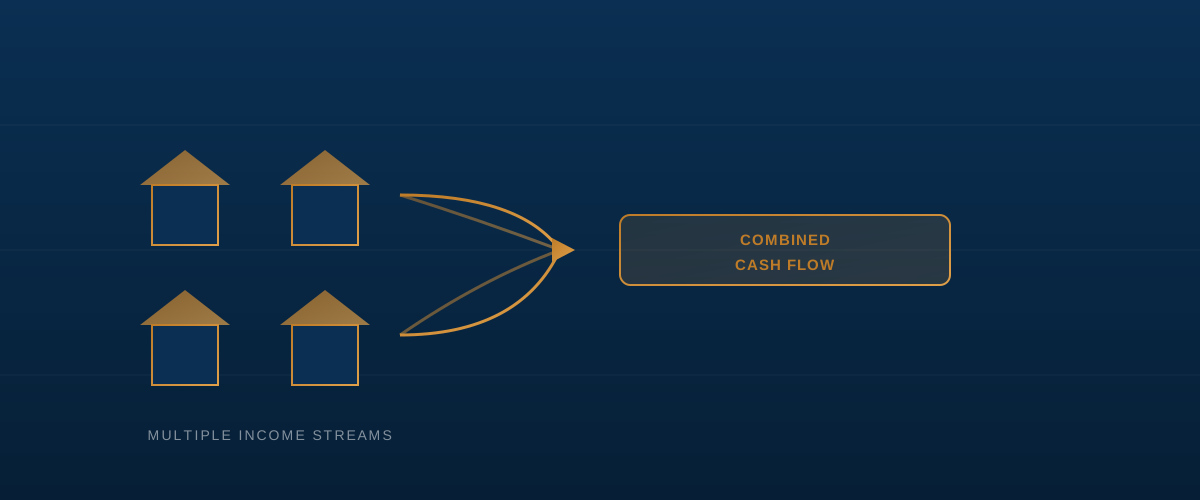
The idea is simple enough to state in a sentence and powerful enough to reshape a financial life: instead of pouring everything into one asset and hoping it performs, you assemble a collection of income-producing assets that support and strengthen one another. When one wobbles, the others hold. When one succeeds, its gains fund the next. Over time, that structure does something a single asset never can — it becomes more stable and more productive as it grows, rather than more fragile. The rest of this article walks through exactly how that works in real estate, and how to start.
The Fragility of a Single Income Stream
Most people spend their working lives depending on one income stream: a job. It feels stable right up until it isn't. A layoff, an industry downturn, a health issue, or a company restructuring can eliminate that single stream overnight, and with it the entire financial foundation of a household. Depending on one source of income is a concentration risk, even when it doesn't feel like one.
The wealthy understand this instinctively, which is why almost none of them rely on a single stream. They build portfolios — multiple assets, each producing income, each partially independent of the others. If one falters, the others carry the weight. That is not just a defensive move; it is the engine of compounding wealth, because multiple streams can be reinvested into still more streams. Musk's empire is an extreme, headline-grabbing version of this. A rental portfolio is the accessible, grounded version available to almost anyone.
What "Bundled Power" Actually Means
The insight the analysts kept circling on is that Musk's assets are not just numerous — they reinforce each other. His platform amplifies his companies. His companies generate data that feeds his AI. His attention drives capital toward whatever he is building. The whole is worth more than the sum of the parts because the parts are connected.
A real estate portfolio has the same quality when it is built well. Each property is an income stream, but the properties also reinforce one another in concrete ways:
- Equity in one property funds the next. As a rental appreciates and its loan is paid down, the equity that builds up can be tapped to acquire another property — each asset helping to create the next.
- Cash flow smooths the whole. When several properties each produce rent, a vacancy or repair in one is cushioned by the income from the others. The portfolio is far steadier than any single property.
- Scale improves your terms. A track record across multiple properties makes you a more credible borrower and can open the door to portfolio-level financing that a first-time buyer can't access.
- Diversification reduces risk. Properties in different markets or of different types are exposed to different local economies, so a downturn in one area doesn't sink the whole portfolio.
This is bundled power translated from billionaire scale to investor scale. You are not just collecting properties; you are building a system where each asset strengthens the others.
How a Rental Portfolio Compounds
The mechanics of how a portfolio grows are worth spelling out, because they reveal why multiple streams beat a single big bet over time. Picture an investor who buys their first rental property. The tenant's rent covers the mortgage and expenses and produces some cash flow. Over a few years, two things happen quietly and simultaneously: the property appreciates in value, and the loan balance shrinks as the tenant effectively pays it down. Both build equity.
At some point, that accumulated equity becomes usable. Through a cash-out refinance, the investor can pull equity out of the first property — without selling it — and use it as the down payment on a second. Now there are two income streams. Repeat the process, and there are three, then four. Each property throws off cash flow and builds equity, and that equity seeds the next acquisition. This is the compounding engine behind nearly every substantial rental portfolio, and it is a direct echo of how Musk's assets fund and reinforce one another, just at a scale any disciplined investor can reach.
The bundling loop: Buy a property → collect rent and build equity → refinance to pull equity out → use it to buy the next property → repeat. Each asset helps create the next, and the growing collection of income streams reinforces itself.
The Financing That Makes Bundling Possible
Here is where many would-be portfolio builders get stuck, and where the right financing changes everything. Conventional mortgages are built around your personal income and cap how many you can hold. Try to scale past a few properties with conventional loans and you hit a wall — the lender starts counting all your mortgages against your personal debt-to-income ratio, and eventually says no.
Investor-focused financing is designed to remove that ceiling. A DSCR loan qualifies each property on its own rental income rather than on your personal tax returns, so your ability to keep buying is not limited by your W-2 or how many loans you already hold. This is the single most important tool for building a bundled portfolio, because it lets each property stand on its own feet.
Once you hold several properties, a bridge loans can take bundling a step further — financing multiple properties under a single loan with one payment, and often a partial-release feature that lets you sell or refinance individual assets without unwinding the whole thing. This is the financing equivalent of Musk's interconnected empire: separate assets, managed as a reinforcing whole.
Multiple Streams Within Real Estate Itself
Bundling does not only mean owning more of the same thing. Within real estate, there are several distinct income strategies, and a sophisticated investor can combine them so that different parts of the portfolio behave differently and capture different opportunities.
- Long-term rentals provide steady, predictable monthly cash flow — the stable core of most portfolios.
- Short-term and vacation rentals can produce higher income in the right markets, adding an upside stream, financed through programs that qualify on nightly rental income.
- Fix-and-flip projects generate lump-sum profits rather than monthly income, adding a different rhythm of returns through short-term rehab financing.
- Multi-family properties bundle several income streams into a single building, capturing the strength of multiple units at once.
An investor who combines these is bundling in the truest sense — not just multiplying identical streams, but assembling different kinds of income that reinforce and balance each other. Steady rentals fund flips; flip profits seed new acquisitions; higher-yield short-term rentals boost overall returns. Each strategy strengthens the whole.
Study the System, Don't Copy the Man
One of the sharpest observations to come out of the Musk coverage was a warning: do not copy his style, study his system. Musk takes enormous, concentrated, high-risk bets that would be reckless for almost anyone else. His public persona is a volatility machine. Imitating that is a mistake.
But the underlying system — build multiple reinforcing assets, use each to strengthen the others, own the infrastructure that generates income rather than depending on a single source — is sound and transferable. For an ordinary investor, the real-estate version of that system is not reckless at all. It is methodical: acquire a sound, cash-flowing property; let it build equity; use that equity to acquire the next; diversify across property types and strategies; and finance it all in a way that lets each asset stand on its own. That is how you capture the wisdom in Musk's system without inheriting the risk in his style.
Building Your First Reinforcing Streams
If this resonates but you own only a home or nothing at all yet, the path in is straightforward. Bundling starts with a single well-chosen property, because the first stream is what makes the second possible. The goal at the beginning is not scale — it is buying one sound, cash-flowing asset that you can hold and build on.
Focus first on cash flow, since that is what makes the whole system self-sustaining. Before buying, confirm the rent will comfortably cover the property's full cost using a DSCR calculator. Then get your financing aligned with a portfolio mindset from the start — a DSCR loan that qualifies on property income keeps your personal finances from becoming the bottleneck as you grow. And think about the second property before you even close on the first, because the equity and experience from property one are the raw material for property two.
Do that consistently, and within a few years you can go from a single income stream to a small portfolio of reinforcing ones — the same fundamental structure that makes the world's largest fortunes resilient, built at a scale that works for you.
What Bundling Looks Like in Practice
To see how these ideas connect, follow a hypothetical investor over several years. She starts with a single rental property, purchased with a modest down payment and a DSCR loan that qualifies on the property's rent. In year one, she has exactly one income stream, and it quietly covers its own costs while producing a little cash flow.
By year three, the property has appreciated and the loan balance has come down, so meaningful equity has built up. She does a cash-out refinance, pulls that equity out without selling, and uses it as the down payment on a second rental in a different neighborhood. Now she has two streams, in two locations, exposed to two different local rental markets. If one has a slow month or a vacancy, the other keeps producing.
By year six, she repeats the process again, and adds a short-term rental in a nearby tourist market for higher-yield income. She now has three properties, three income streams, and two different rental strategies balancing each other. When she eventually wants to simplify, she folds several of them into a single portfolio loan with one payment. What began as one property has become a small, reinforcing system — each asset having helped create the next. None of this required a fortune to start; it required one sound property and the discipline to let it compound. (This is an illustrative scenario; real timelines and outcomes depend on the markets, the properties, and the financing.)
Common Mistakes When Building Multiple Streams
Bundling is powerful, but there are a few predictable ways investors trip themselves up, and knowing them in advance keeps the system healthy.
Scaling faster than the cash flow supports. The excitement of adding properties can tempt investors to stretch, buying the next one before the last is truly stable. But the whole point of multiple streams is resilience, and that only works if each property genuinely covers itself. Grow at the pace your cash flow actually supports, not the pace your ambition wants.
Ignoring reserves. A portfolio of properties means a portfolio of possible repairs and vacancies. Investors who reinvest every last dollar without keeping reserves can find a couple of simultaneous problems turning a strength into a strain. Healthy bundling includes a cash cushion so the streams stay independent rather than domino into each other.
Over-concentrating in one market. Buying five properties on the same street feels like bundling, but it actually concentrates risk — one local downturn hits all of them. True diversification means spreading across different neighborhoods, markets, or property types so the streams are genuinely independent.
Using the wrong financing. Trying to build a portfolio on conventional loans eventually hits the debt-to-income ceiling and stalls. Matching your financing to your strategy from the start — property-income-based DSCR loans, and portfolio loans as you scale — is what keeps the system growing instead of grinding to a halt.
Why This Approach Matters More in 2026
The bundled, multi-stream approach is timeless, but there are reasons it feels especially relevant right now. The same market volatility that sent Musk's paper wealth on a trillion-dollar round trip is a reminder that single-point financial dependence — whether on one stock, one company, or one paycheck — carries real risk in an uncertain environment. When markets are choppy, the value of income that arrives every month regardless of sentiment goes up.
Real estate's appeal in this climate is precisely that its income streams are anchored to something durable: people always need somewhere to live. A diversified set of rental properties keeps producing through market cycles in a way that a concentrated paper position simply cannot promise. For investors watching headlines about fortunes swinging by tens of billions in a week, the case for building steady, reinforcing streams of real income has rarely been clearer.
It is also more achievable than many assume. The financing tools that make portfolio-building possible — loans that qualify on property income rather than personal tax returns, and portfolio loans that manage multiple properties as one — are accessible to everyday investors, not just institutions. The barrier to bundling is not usually money or access; it is knowing that the strategy exists and having the discipline to execute it one property at a time.
The Takeaway
Musk's trillion-dollar swing grabbed the headlines, but the more useful story was the one underneath: his strength comes from bundled, reinforcing assets, not a single bet. That principle is not reserved for billionaires. It is the exact logic of a well-built rental portfolio, where each property produces income, builds equity, and helps fund the next — a system that grows stronger and steadier as it scales.
You do not need six companies to apply the lesson. You need a first property, sensible financing, and the discipline to let each asset help create the next. If you are ready to start building reinforcing income streams, that is exactly what we help investors finance. Send us your scenario and we will show you how to structure it — usually with a real answer within 24 hours.